A Boardroom Bot That Fires the Tab Babysitters, a Hollywood Handshake for Your Docs, and a Robot That Holds the Merge Button


Local preview — subscriptions are not connected yet.
Most coding agents give us one chat session per job.
Five jobs means five tabs, and someone, usually us, has to sit with every one of them.
DeepSeek reckons a person can keep track of only three to five live sessions at once (English translation of their design post).
Lord Sugar would never put up with that.
He sets the task, sends the teams off, and only sees them again in the boardroom.
So DeepSeek (@deepseek_ai) open-sourced dsh-superagent, a coding agent that joins the team as one always-on bot instead of a pile of chat windows.
It's for teams who already live in GitHub issues and pull requests, and want to hand jobs over there without anyone babysitting a session.
How does the boardroom work?
It's a research prototype that runs as a plugin for DeepSeek Harness, DeepSeek's open-source agent app.
It watches one GitHub repo, and can also listen to Feishu chats (ByteDance's Slack-style work chat, sold outside China as Lark).
We @mention it on an issue or in a chat, just like asking a teammate.
A resident Router reads the request and turns it into a Ticket, but never does the work itself, and DeepSeek says it may not even get a Bash tool.
Each Ticket gets its own Worker session and folder, and the result lands back in the same thread, usually as a pull request.
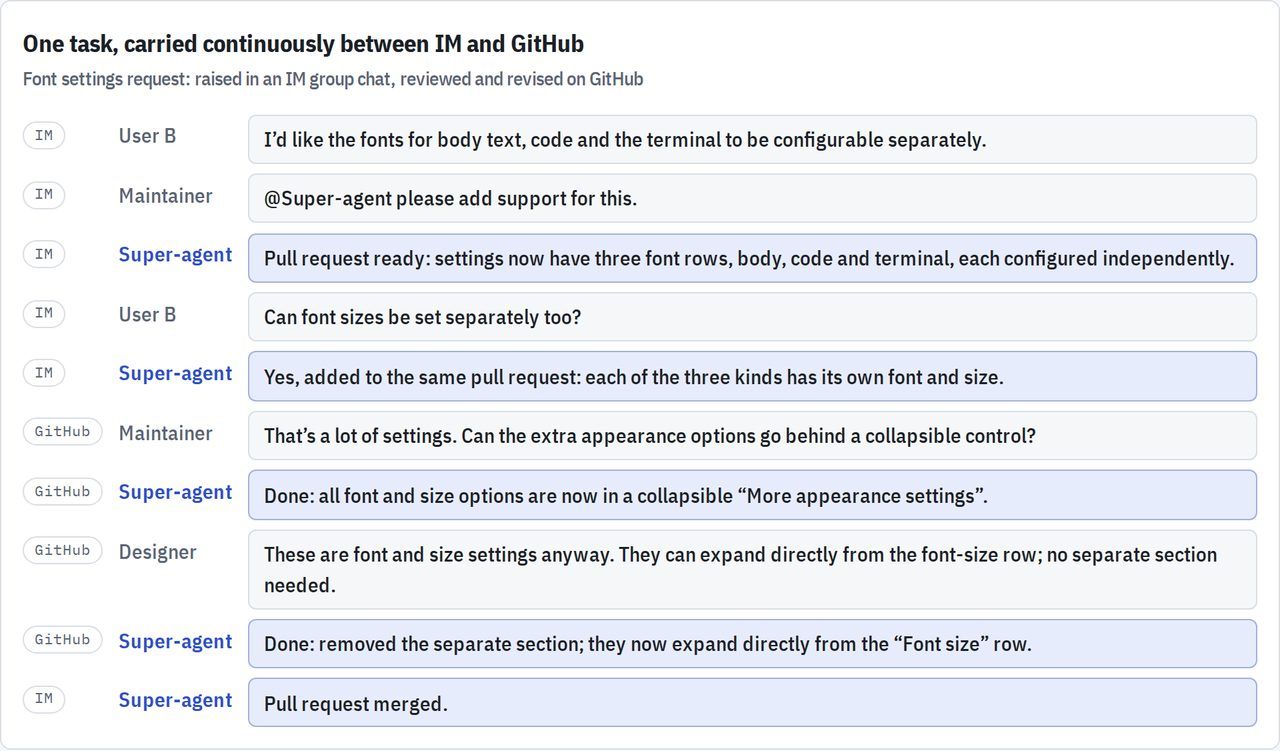
Review comments on that pull request go straight to the same Worker…
So nobody has to mention the bot again or re-explain the job.
So what do we stop doing?
Before, we opened a session per job, pasted in the context, checked each tab and carried PR feedback back to the right chat.
Now we ask once where the work already lives, and get one "on it", then silence, then a pull request, a question or an honest failure.
A local web panel lists only what needs a person.
In DeepSeek's simulated test of about 300 chat and CI messages, the median job took 12.4 minutes from request to result, against 20.4 for a single session handing work to subagents.
Will it take on tasks nobody set?
Only if the team writes a rule for it.
Even then it starts in observe mode, which records what it would have done without doing it.
Should we hand it the keys?
Not yet.
DeepSeek calls it research code rather than an official product.
The deployment docs warn that Workers run with full access as our own OS user.
A dedicated OS account holding only the agent's credentials is the place to start.
Setup is a chat where our coding agent reads SETUP.md and asks one question at a time.
It's already past 22,000 GitHub stars.
Meanwhile, the engineer still babysitting five chat tabs is the one hearing…
"You're fired."

No predictions, just what actually works.
Every developer is experimenting with AI. Fewer talk honestly about what worked, what quietly broke and what they'd never do again. On December 4, AI Coding Summit brings that conversation to Berlin, and on December 7 it continues online. 30+ talks and workshops cover agentic workflows, AI code review, production agent patterns, security risks in AI apps, observability and evaluation, with Daniel Sogl, Mike Grabowski, Julia Kordick, Daniel Ávila and Nico Martin.
And we are thinking of joining the party; come say hi!
Use code FRIENDS for 10% off.
In a Bake Off technical, Paul Hollywood hands over a recipe with half the steps missing, then watches who works it out.
Our docs now sit that test every day, because more developers just tell a coding agent "set this library up for me".
The baker is Claude Code, the recipe is our docs, and when it guesses an old command or gives up, nobody tells us where it went wrong.
The developer just blames our library and picks another one.
Evan Doyle (@evandoyleDEV) and the Gauge (@gauge_sh) team just showed off on Hacker News their open-source Gauge CLI, which plays Hollywood for us.
It hands our docs, skills (instruction files a coding agent loads for a task) and CLIs to real coding agents, and shows exactly where they get stuck.
It's for anyone whose product coding agents now use on someone's behalf: SDK, CLI and docs teams, devrel, or anyone publishing a skill.
Clerk, for example, wanted agents to stop using its old "keyless" mode and run its new clerk init command instead.
Gauge says Clerk tested new SDK error messages with it before release, then saw three times as many agents use clerk init after the deploy.
How does the bake work?
We write a realistic task, like "write the release notes for 1.2.0", plus what a pass looks like.
Gauge runs Claude Code, Codex, Pi or OpenCode on it in fresh Docker containers, using our own subscriptions or API keys and no Gauge account.
For docs, a web fixture serves our draft pages at the real address through a mitmproxy sidecar (a proxy that sits between the agent and the internet), so the agent thinks it's reading the live site.
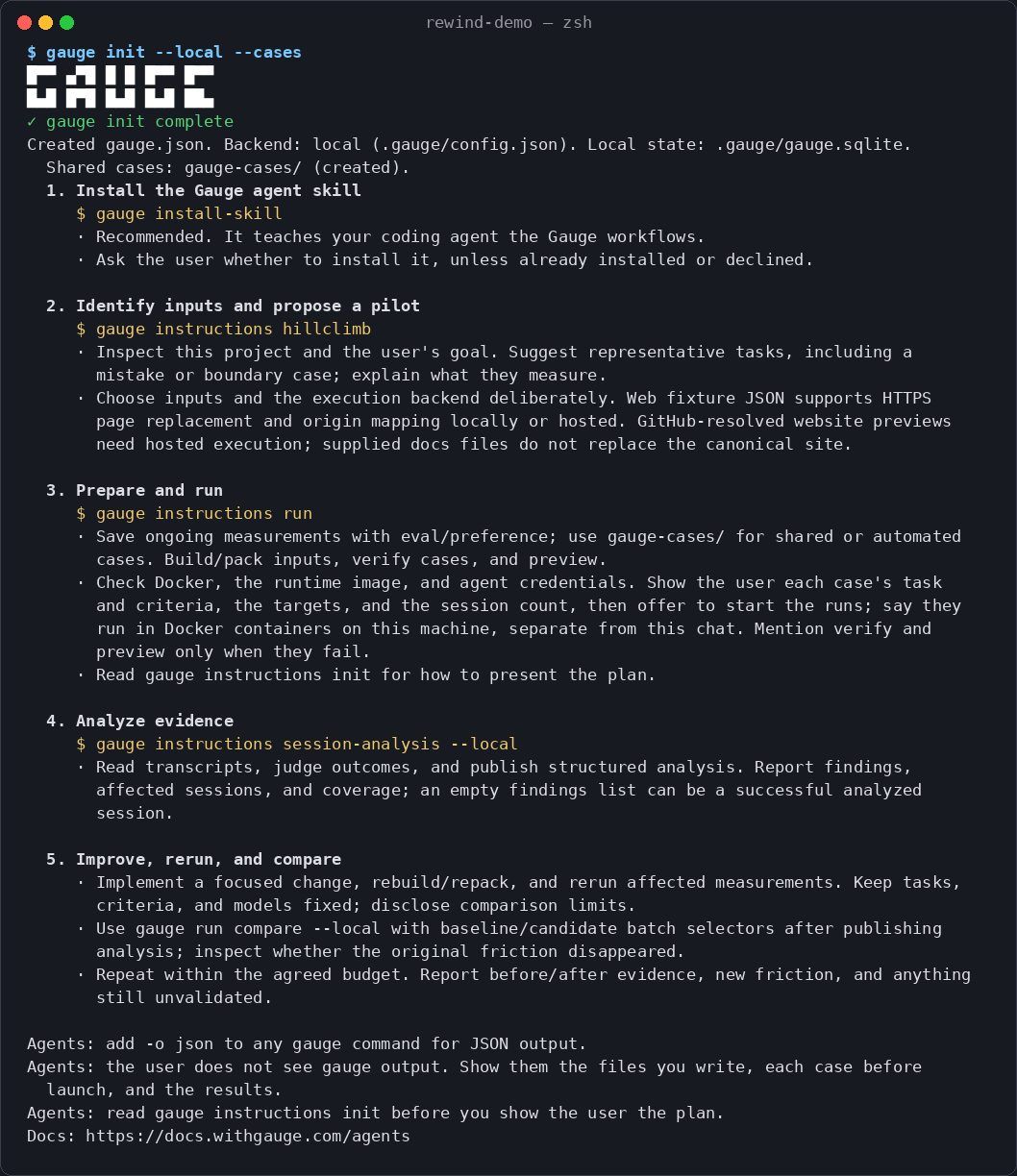
Real output of gauge init --local on a throwaway project
Who does the judging?
Our own coding agent reads the transcripts (the full log of what the test agent did) and flags friction, like an interactive command that blocks, a deprecated API, or a skill the agent never opened.
Then it edits the docs or skill, reruns the same task and compares the two batches.
npm install -g @withgauge/cli
gauge local runtime pull
gauge init --local
# preview, then run a saved eval
gauge run --eval <eval-id> --local \
  --input release-notes --dry-run
gauge run --eval <eval-id> --local \
  --input release-notes
# after the fix, compare the two batches
gauge run compare --local \
  --baseline batch=<before-id> \
  --candidate batch=<after-id>
So what do we stop doing?
Before, we found out our docs had a soggy bottom when a user complained, or never.
Now we test the draft on the same agents our users run, before we publish, and only ship the version that gets them through.
Anything to watch?
It needs Node.js 22.13 or newer and Docker.
Every rerun spends real agent tokens on our own subscription or API key.
Logged-in MCPs and APIs, website previews from GitHub and tracking results over time need Gauge's hosted mode, which runs on credits.
Anonymous usage telemetry is on by default, and gauge telemetry disable turns it off.
When the agent finishes first time with no questions…
That's as close as our docs will get to a Hollywood handshake.

Tell a cloud agent you want an app and it scaffolds it, adds Postgres and Cursor SSO, runs security checks and hands back a live link… localhost finally gets a day out.
Named, long-running agents in Kiro Crew with their own memory, dashboard and schedules, spinning up worker sessions and only pinging you for decisions… middle management, but it actually reads the tickets.
📦 Copilot in Xcode's Coding Assistant
Copilot now plugs straight into Xcode's built-in assistant, in public preview from Xcode 27.3 beta on every Copilot plan… no extension, just Settings > Intelligence.
Pick Copilot in Air's agent picker over ACP and run parallel sessions locally, or in fresh cloud VMs on your Copilot plan instead of JetBrains AI credits.
The Copilot app can now merge a PR itself once checks pass, plus /settings in the CLI and cron schedules for local automations in VS Code 1.145… the robot holds the merge button now.
Review settings are now manageable over REST and GraphQL, comments say which skills and MCP servers they came from, and balanced reviews use three models plus a fourth to referee.
MCP tasks move to the background automatically, and permissions.denyInsteadOfPrompting denies a blocked tool call and keeps going… no more coming back to an agent frozen on a Y/n.
codex agents --no-daemon opens a command centre that marks unread results, and you can switch backends without losing your draft… an inbox for your agents.
A new models command and --list-models flag show what you can actually run, and the IDE companion now reaches into container sandboxes.
Vercel MCP's first MCP App shows live deploy status, build logs and a Visit button right inside ChatGPT… send the logs to the model and let it find the typo.
📝 Firefox DevTools MCP Updated
Agents can drive Firefox over WebDriver BiDi with the console, network, debugger and profiler, and a new idle timeout frees the browser sooner… just give it its own profile, not yours.
📦 Handoffs
A Claude Code mod that turns Claude's requests into checklist cards in a pane, with steps to tick, decision buttons, and Open and Copy buttons… so they don't scroll away while you're busy elsewhere.

Local preview — subscriptions are not connected yet.