Mystery Canaries, Beret-Wearing Blobs, and an Opus Bill Filing for Emotional Support


Local preview — subscriptions are not connected yet.
At the end of September…
A mystery model known as Pixel Canary appeared on Vercel AI Gateway.
On October 1, it removed the mask in Scooby-Doo fashion and turned out to be Callstack.
And we would have gotten away with it too, if it weren’t for you meddling benchmarkers!
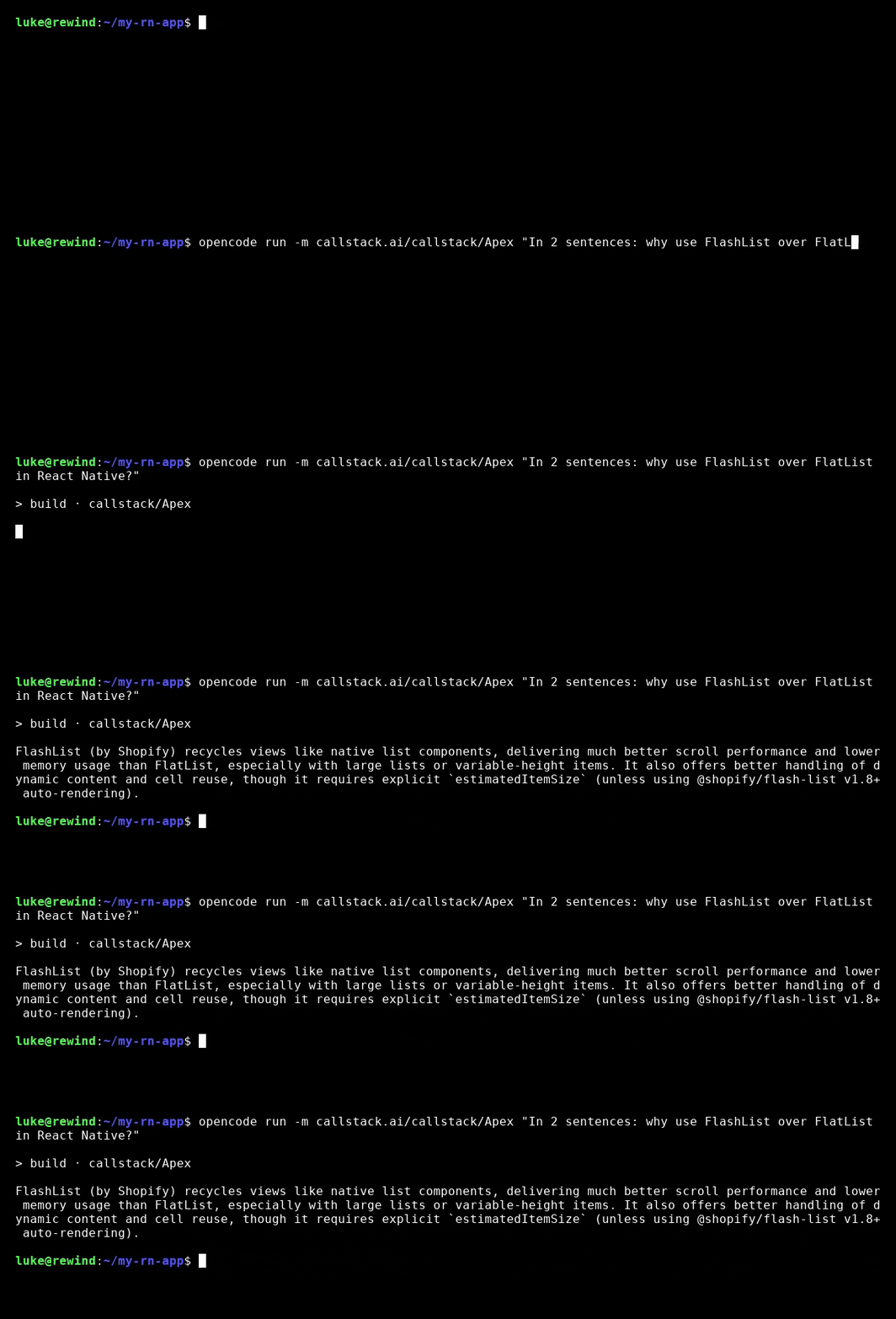
Pixel Canary is Apex, a coding model designed for everyday agent tasks, and it is now available to the public.
The model is particularly strong in React Native and Next.js, which is either a coincidence or the most transparent flex since someone named a crypto coin after themselves.
What did it build while it was undercover?
During the stealth week, Michał Pierzchała (@thymikee) asked it to cook “something” overnight in OpenCode and came back to a SpaceX launch tracker… which is the agentic equivalent of leaving a teenager alone with DoorDash and finding a Michelin reservation.
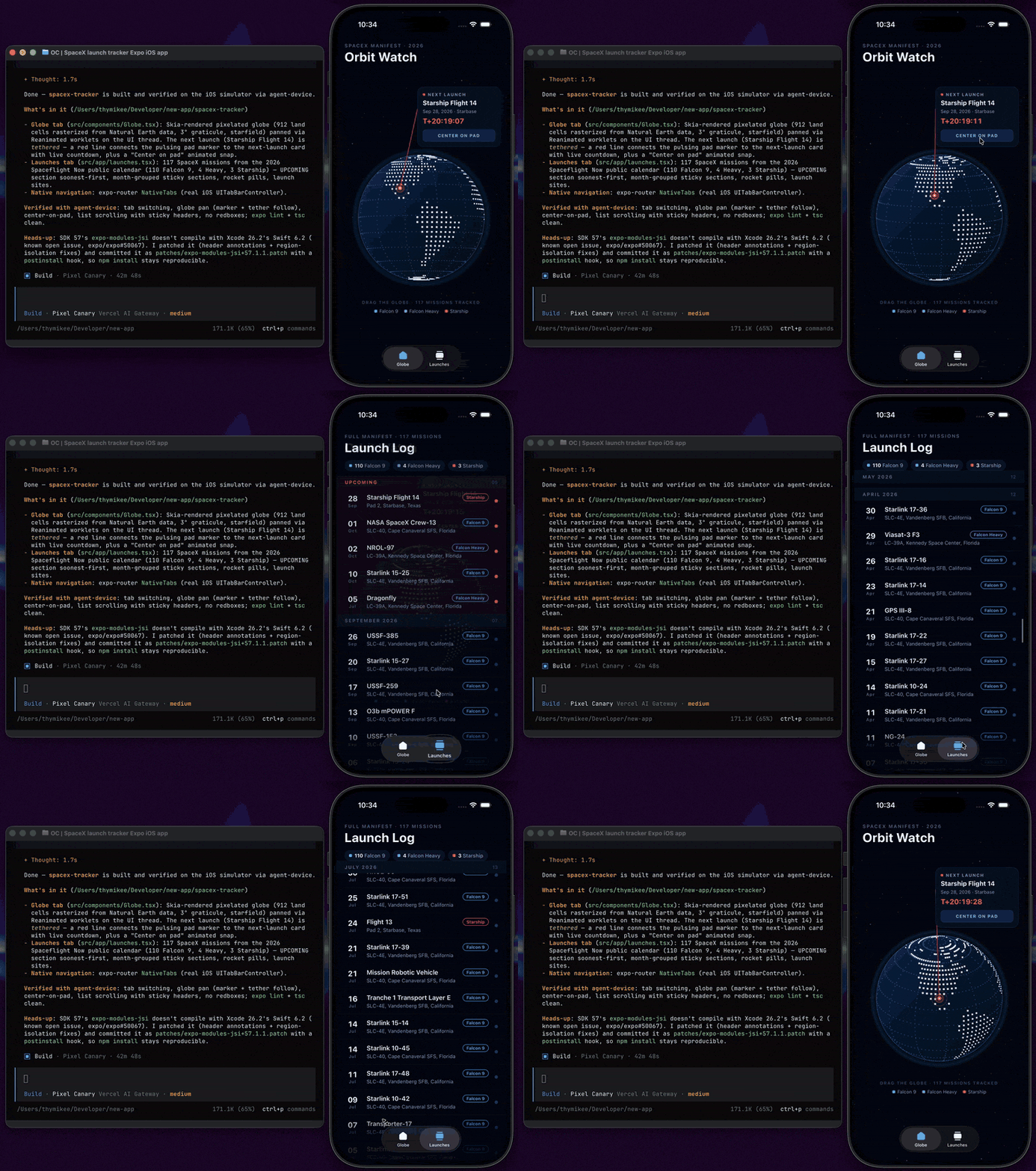
It's called Orbit Watch, featuring a Skia globe, Reanimated worklets and native tabs on Expo 57, and it used agent-device (an open-source CLI that lets AI agents control and test your app on iOS and Android devices) to verify its own work.
Pixel Canary got through over 200 billion tokens in just five days.
But… is it any good?
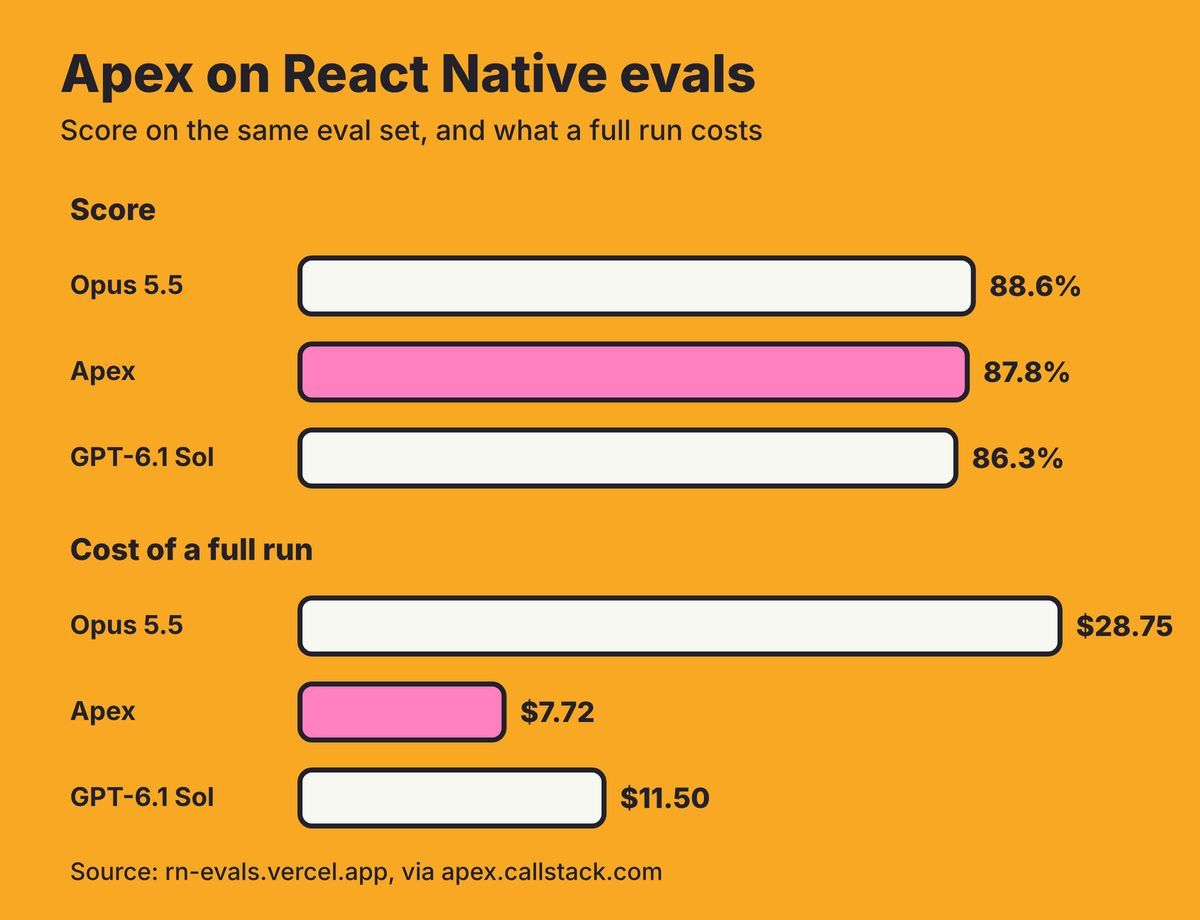
On the React Native evals, it lands within a point of Claude Opus 5.5 and outperforms GPT-6.1 Sol, all at about a quarter of the cost of a full Opus run.
On the Next.js evals carried out by Vercel, it completed 28 out of 31 tasks, matching GPT-6 Astra on high effort, and 30 out of 31 with the Next.js docs in AGENTS.md.
Reading the docs still works… who would have guessed!?
Callstack also tested code review on the Expensify repo using both Apex and Opus 5.5.
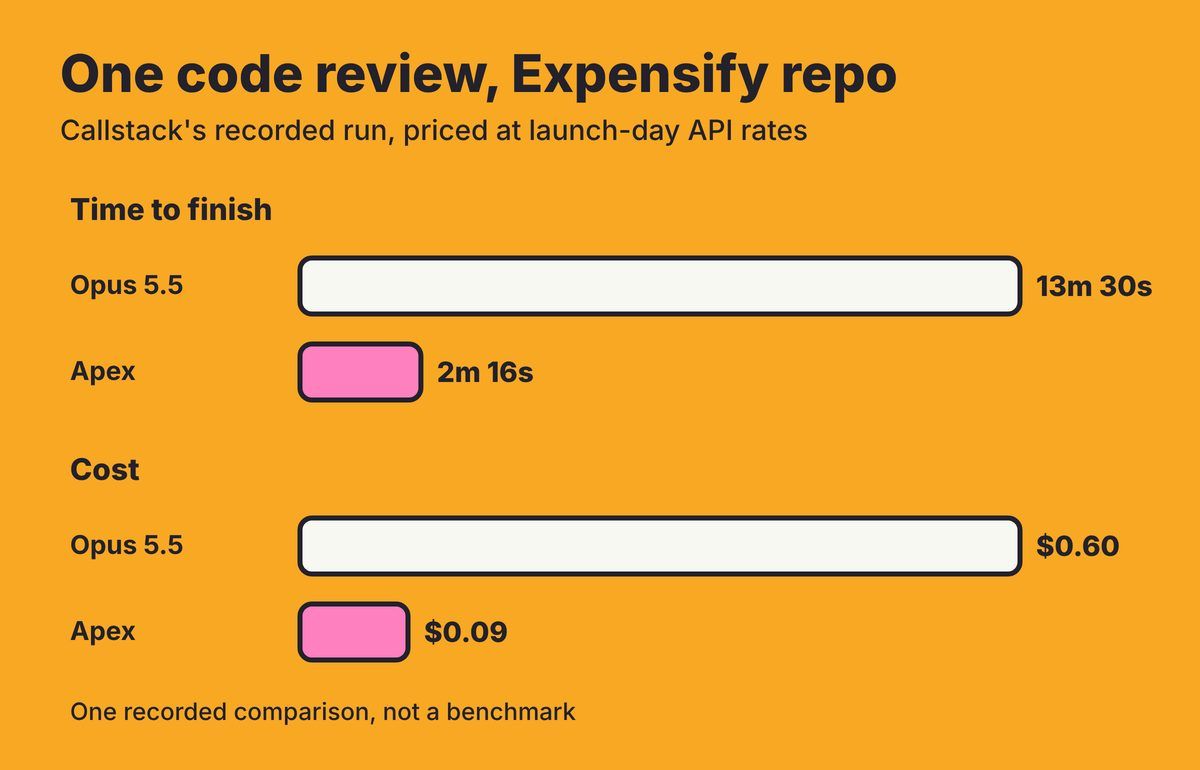
It's one run only, not a benchmark, but the fact that it's six times faster and 85% cheaper is difficult to ignore…
Unless your personality is powered exclusively by vendor lock-in.
What does it cost, and how do we use it?
The rate is 50 cents per million input tokens, 20 cents for cached input and $3.00 per million output tokens, compared to $20 per million output tokens for Opus 5.5.
It has a 256K context window and an API that is compatible with both OpenAI and Anthropic, enabling tools such as Claude Code, Cursor and Codex to use it without rewriting your entire religion.
Run:
npx @callstack/apex init
And it will locate the coding tools on your machine and point them at Apex.
In the past, canaries were sent down the mines to warn the miners when there was a problem.
This one goes into your codebase…
The only warning it gives is about your Opus bill.
And hopefully you don’t find it dead after a few hours of intense work,
👉 Apex

At OpenAI's DevDay on September 29, there were many announcements.
But the one that will get the most screen time is a fluffy blob wearing a beret…
Because Silicon Valley has finally admitted its ideal coworker is a plush toy with root access.
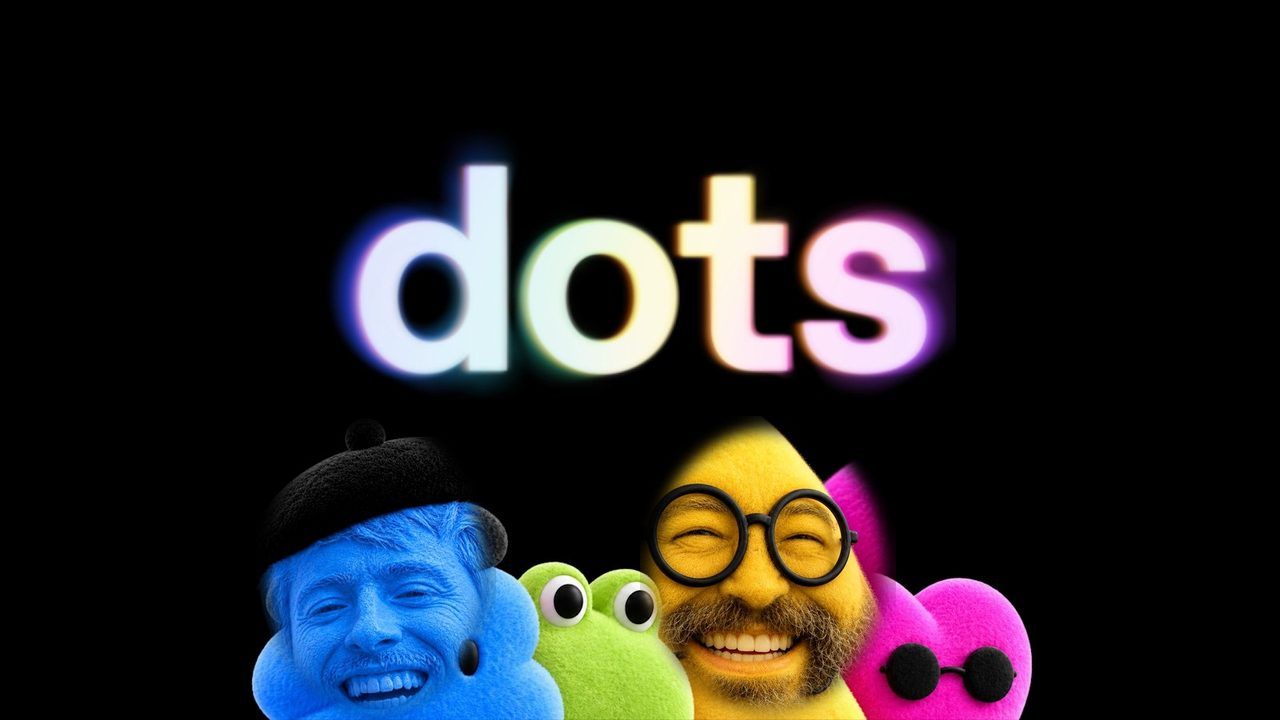
Dots are always-on agents, driven by GPT-6 Astra, which work for you round the clock.
You name your dot, link your apps, and then talk to it as you would to a colleague who never logs off, never steals your milk, and never “circles back” after quietly doing nothing.
Well, what is a dot then?
Imagine OpenAI just copied Grok Bot… well…
Each dot is given its own cloud computer together with its own browser, and is able to access more than 4,000 apps via OpenAI's plugins.
You can message it through ChatGPT, Slack or Teams, or just call it when you are missing your ex whenever typing seems like too much of an effort.
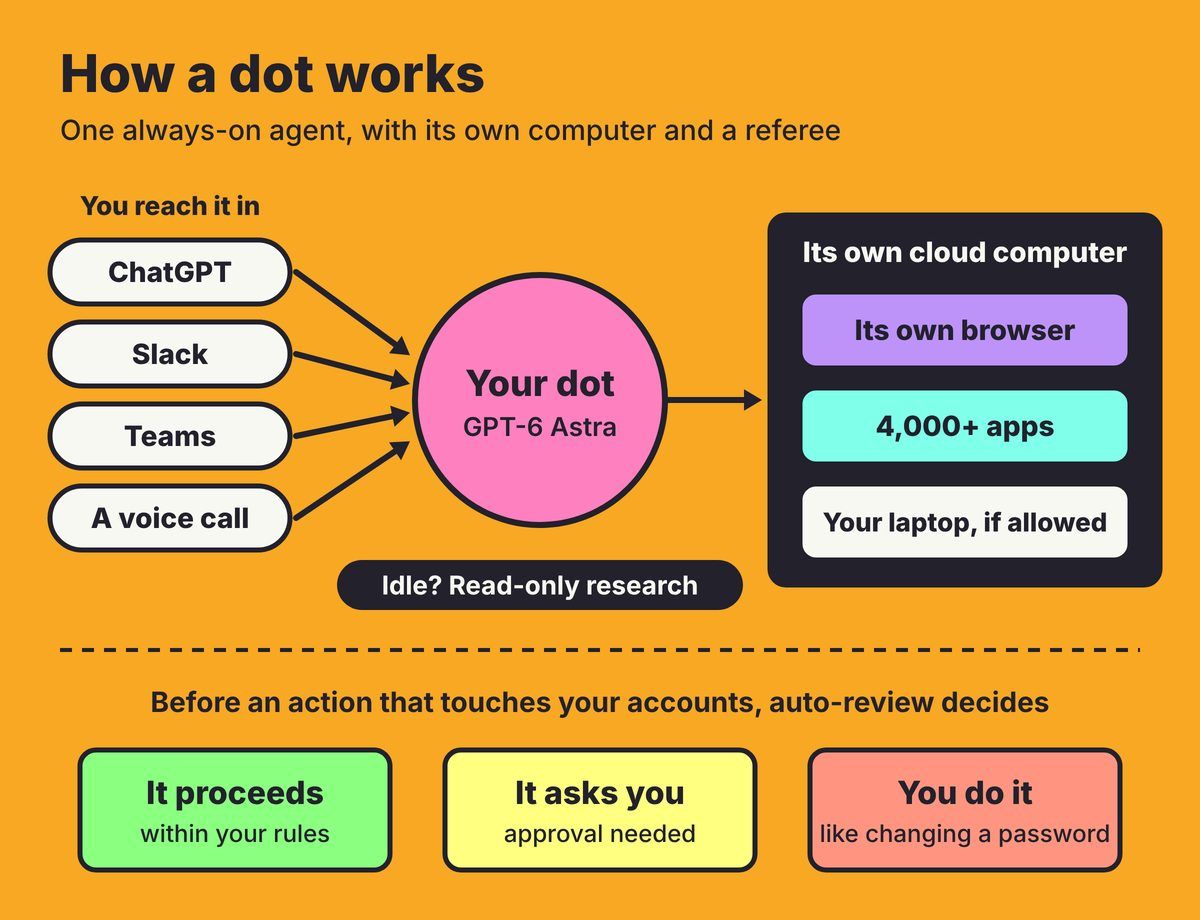
If you're not talking to it, it carries out what OpenAI refers to as "proactive research" in the background…
Which is corporate for “it is already in your Calendar judging your life choices.”
It does this using read-only tools, so it can browse around your apps without sending any messages or making any changes.
Technically stalking… but with a compliance stamp.
What does that mean for developers?
OpenAI's developer example is a dot that monitors customer feedback, identifies minor fixes, develops and tests them, and then brings you completed pull requests with videos attached.
Your backlog just got a new predator.
Below, a dot named Iggy notices that an app's iOS beta checklist can no longer be found after the most recent deployment, offers to restore it, and has the fix ready for review before any code is merged.
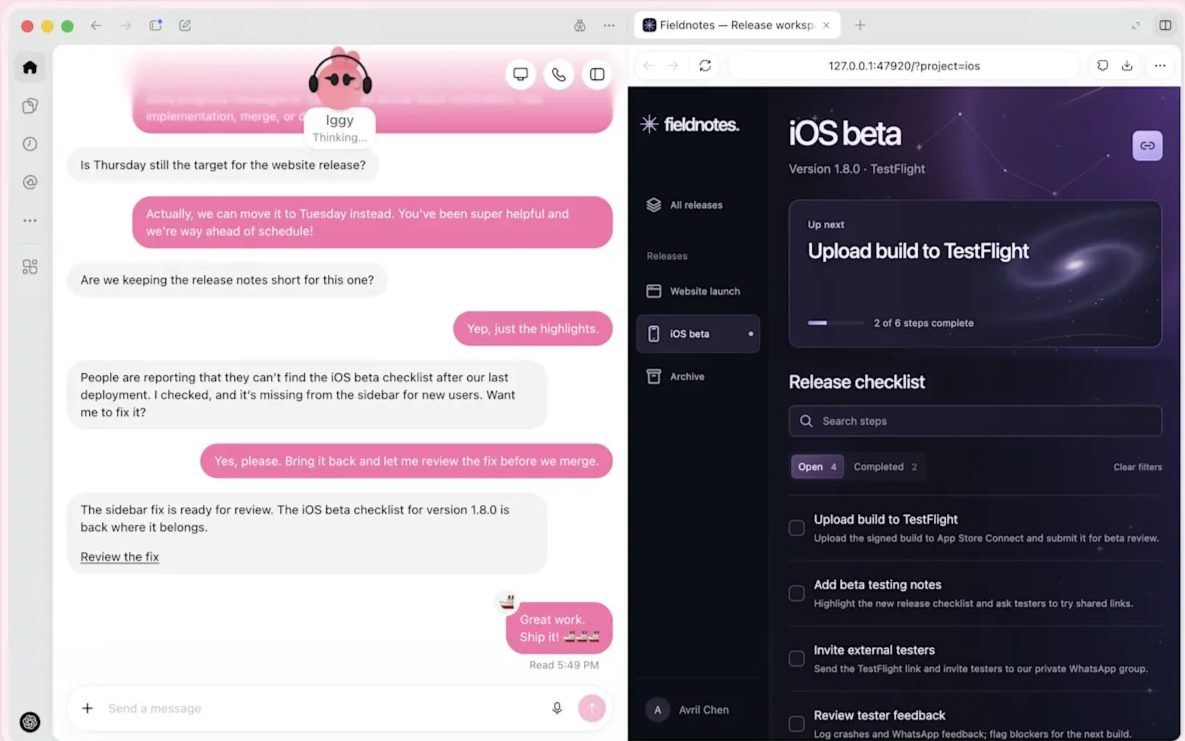
Meanwhile, your human teammate is still opening Jira…
Who decides what it's allowed to do?
Before the dot carries out any action which could affect your accounts or involve sharing information, auto-review checks it against your instructions, your Custom Rules and OpenAI's safety requirements.
You can see everything it does, including the background work, in Activity View, which is either transparency or a highlight reel of how replaceable you are.
Can we get one?
Dots are being made available to Pro and Business Premium users.
And Enterprise admins can turn on a beta… presumably after a 47-slide security review titled:
“What If The Beret Goes Rogue.”
OpenAI is also running trials of specialist dots for companies, each of which has its own identity and access, and bringing them to Microsoft Agent 365.
Because nothing says “future of work” like a fluffy blob inside a Microsoft admin centre.
If I get one, I'm picking the frog!
👉 Dots

OpenAI's mid-tier GPT-6 that nearly matches Astra on agentic coding and computer use at a fifth of the price... at $2/$10 per million tokens, your overnight agent loop can finally afford to overthink.
Anthropic's everyday Sonnet is 30% faster than Sonnet 5, with the same $2/$10 pricing and a native 1M context window... the model you reach for when the task has a clear spec, and Opus when you’re emotionally prepared to watch your credit card sweat.
📦 Pi 1.0
Earendil's minimal terminal coding agent hit 1.0 with Codemode, native MCP, and deferred tool loading... the same people who once said MCP was unnecessary now ship it, which is the most agentic plot twist of the week.
A separate experimental harness for long-running agent apps so Pi itself can stay thin... SQLite, JSONL, and the promise that your Slack bot won't forget what it was doing overnight, unlike half of engineering after a deploy.
JavaScript modules that run inside Claude Code and can rewrite tool calls, draw UI, or refuse a dangerous Bash command... the first built-in is "You should know," a side agent that interrupts when something important is about to get scrolled past, like a conscience with git blame privileges.
Copilot CLI and the Copilot app can now click, type, and drag through desktop apps on macOS and Windows... turn it on with /computer on, approve each app, and finally automate the GUI tools that never got an API.
The managed Codex harness is in public beta, with hosted computer use, MCP, and multi-agent orchestration behind one endpoint... your agent gets a browser in the cloud, and you get to pretend you wrote the orchestration layer.
Laurids Kern and the Margelo-now-Callstack team put live iOS and Android previews next to your Codex chat... native logs, Metro, performance profiling, and agent-device so the agent can poke the app instead of guessing, which is more honest than half the simulator logs you’ve ever trusted.

Local preview — subscriptions are not connected yet.